

Serviced Offices vs Traditional Office Leases in Qatar: Full Cost Comparison
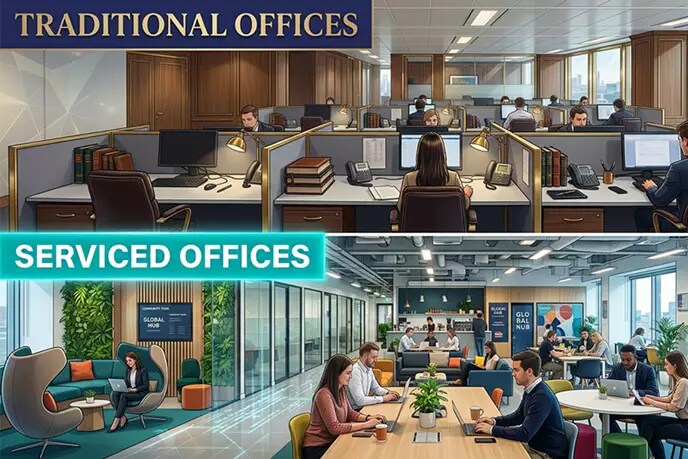
A full cost comparison of serviced offices vs traditional office leases in Qatar, with real numbers for fit-out, deposit, lease term and QFC vs mainland.
Serviced Offices vs Traditional Office Leases in Qatar: Full Cost Comparison
When a company prices office space in Doha, the monthly rent is rarely where the real difference sits. The gap between a serviced office vs a traditional office lease in Qatar shows up in the money you spend before anyone sits down: the fit-out, the furniture, the multi-month deposit, and the years you commit to. For a foreign company relocating to Qatar, or a local business trying to cut costs or move to a new premises, those upfront figures often decide the budget more than the headline rate per square meter. This guide sets the two models’ side by side with real 2026 market numbers for Doha, covering fit-out, deposits, lease terms, running costs, and how registering on the mainland or through the QFC changes what your office needs to be.
The figures below are market estimates for West Bay and comparable Grade A districts in 2026. Actual quotes vary by tower, size, and negotiation, so treat them as planning ranges rather than fixed prices.
Serviced Office vs Traditional Lease: The Two Models at a Glance
A traditional office lease means renting a bare or semi-fitted unit directly from a landlord, then fitting it out, furnishing it, connecting utilities, and arranging cleaning, reception, and security yourself. A serviced office is a private, furnished suite inside a managed business center where rent, fit-out, furniture, utilities, internet, reception, and cleaning are bundled into one monthly fee.
Across the Qatar office market, serviced offices and traditional leases sit at opposite ends of the spectrum, with coworking spaces and shared desks offering a lower-cost middle ground for very small teams. This comparison focuses on private serviced offices versus traditional leases, the two options most companies weigh when they need dedicated space.
The table below summarizes how the two compare the factors that drive cost.
|
Factor |
Serviced Office |
Traditional Office Lease |
|
Fit-out |
Included |
QAR 800 - 4000 per sqm, paid upfront |
|
Furniture |
Included |
Purchased separately |
|
Security Deposit |
1 - 2 months |
2 - 3 month rent |
|
Agency commission |
None |
Around one month's rent |
|
Typical lease term |
From 1 month, rolling |
1 - 3 years, fitted units often 2 – 5 years |
|
Setup time |
Same day to a few days |
2 – 6 months |
|
Pricing basis |
Fixed, all-inclusive monthly |
Rent plus separate variable costs |
|
Utilities, cleaning, reception |
Included |
Contracted and paid separately |
|
Scaling up or down |
Change plan month-to-month |
Difficult or break the lease |
Upfront Costs: Where the Big Difference Lies
The clearest financial contrast is the capital you commit before moving in. A traditional lease front-loads spending through fit-out and furniture, both of which are largely irrecoverable if you leave early. Fit-out alone ranges from around QAR 800 to 1,200 per square meter for a basic office, QAR 1,200 to 2,000 for a mid-range finish, and QAR 2,000 to 4,000 or more for a premium executive fit-out in a West Bay tower.
The table below models the upfront cost of a small private office of roughly 40 square meters, suitable for four to five people, in a Grade A West Bay building.
|
Upfront Item |
Traditional Lease |
Serviced Office |
|
Fit-out (40 sqm, mid-range) |
QAR 48,000 - 80,000 |
Included |
|
Furniture |
QAR 15,000 - 25,000 |
Included |
|
Security Deposit |
Depending on the rent |
Depending on the rent |
|
Agency commission |
10 – 15% or 1-month rent |
None |
|
Upfront total |
QAR 81,000 - 129,000 |
Security Deposit Only |
For a business relocating within Qatar, this is the number that hurts most, because leaving one leased office and fitting out another means paying for a second fit-out while the first is written off. A serviced office removes that repeat spend entirely.
Monthly and First-Year Running Costs
Once you are in, the comparison shifts. A serviced office carries a higher monthly figure because everything is bundled, while a traditional lease has a lower base rent with several costs added on top. The table below models the first-year running cost for the same 40 square meter office, assuming a rent of around QAR 150 per square meter per month on the traditional side.
|
Cost Line |
Traditional Lease |
Serviced Office |
|
Rent or all-inclusive membership |
QAR 72,000 – QAR 100,000 /year |
QAR 120,000 – |
|
Utilities and Service Charges |
QAR 9,600 /year |
Included |
|
Cleaning, Reception and IT (based on 2 Full-time employees), Security |
QAR 125,000 - 135,000 /year |
Included |
|
Annualized fit-out and furniture |
QAR 30,000 - 50,000 |
None |
|
Indicative first-year total |
QAR 236,000 - 294,600 |
QAR 120,000 - 180,000 |
In the first year the two land in a similar range, but for very different reasons. The serviced office spreads everything into a predictable monthly fee with almost nothing upfront, while the traditional lease looks cheaper on rent yet absorbs a large one-off fit-out that inflates year one in addition to running costs that you save in a serviced office.
The picture changes again from year two. With the fit-out already paid, a traditional lease settles to roughly QAR 105,000 to 115,000 a year in rent, utilities, and services, while a serviced office continues at its all-inclusive rate. For a stable team planning to stay for several years, the traditional lease becomes the cheaper option once the setup cost is behind it. For a company that may grow, shrink, or move within two years, the serviced office usually wins on total cost.
How QFC and Mainland Registration Affect Your Office Choice
Your setup route also shapes what the office must be, because the address is tied to the license. A mainland company registered with the Ministry of Commerce and Industry (MOCI) needs a municipality-approved commercial tenancy, registered through Tawtheeq, though a serviced office suite can satisfy this. A Qatar Financial Centre (QFC) company must hold an office at a QFC-designated location, where flexi-desk and serviced arrangements are accepted for many activities.
|
Factor |
Mainland (MOCI) |
QFC |
|
Foreign ownership |
Up to 100% in most sectors with approval |
100%, no local partner |
|
Where the office can sit |
Anywhere in Qatar with municipality approval |
At a QFC - designated address |
|
Serviced office accepted for registration |
Yes, with a registered tenancy |
Yes, at designated premises |
|
Legal Framework |
Qatari commercial law |
English common law |
|
Best suited to |
Businesses selling to the local market |
Financial and professional services |
Free zone companies are the exception, since Ras Bufontas and Umm Alhoul require premises inside the zone rather than a serviced office in the city. For mainland and QFC setups, a serviced office is often the fastest way to secure a compliant address while the registration is completed.
Which Model Saves You Money?
The honest answer depends on how long you will stay and how certain your headcount is. A serviced office is usually the cheaper and safer choice for a company relocating to Qatar, a startup testing the market, a small team, or any business that wants to avoid tying up capital in fit-out. A traditional lease tends to win for an established company with a stable, larger team that will occupy the same space for several years and wants a bespoke layout and its own branding.
For businesses relocating within Qatar specifically, the serviced route avoids paying twice for fit-out and lets you move in days rather than months. Providers such as Servcorp offer serviced offices in Doha in West Bay towers with rent, furnishing, reception, administrative support, and IT bundled into one monthly fee, which gives a relocating or incoming business a fixed, predictable cost and an immediate professional address while it settles in. That predictability is often worth as much as the raw saving, since there are no surprise fit-out expenses or separate utility bills to manage.
Frequently Asked Questions
Which is cheaper, a serviced office or a traditional lease in Qatar?
It depends on how long you stay. A serviced office is cheaper in the first year and requires almost no upfront capital, since fit-out, furniture, and deposits are avoided. A traditional lease has a lower monthly rent but heavy setup costs, so it becomes cheaper only once your team is big and you occupy the space for roughly 3 years or more.
How much does a serviced office cost per month in Qatar?
As a 2026 guide, a compact private serviced office in Doha starts at around QAR 4,000 to 6,000 per month all-inclusive, with premium West Bay space costing roughly QAR 10,000 to 25,000 per month for 2 to 10 team members. Coworking desks run near QAR 2,000 per month and virtual office addresses around QAR 1,000 to 2,000. Prices vary by location, size, and building.
What upfront costs come with a traditional office lease in Qatar?
Expect to fund the fit-out at roughly QAR 800 to 4,000 per square meter, furniture, a refundable security deposit of two to three months' rent, and an agency commission of about one month's rent. For a small 40-square-meter office these can total QAR 80,000 to 130,000 before you move in, on top of the ongoing rent.
Can a serviced office be used for company registration in Qatar?
Yes. A serviced office with a registered tenancy is accepted for mainland Commercial Registration with MOCI, and QFC companies can register using a serviced or flexi-desk address at a QFC-designated location. Free zone entities are the exception, as they must lease premises inside their zone rather than a serviced office in the city.
Is a serviced office worth it for a company relocating within Qatar?
Often, yes. Relocating to a traditional office means paying for a second fit-out while writing off the first, plus new deposits and downtime. A serviced office removes those repeat costs, lets the team move in within days, and keeps spending to a single monthly fee, which is why many businesses moving premises in Qatar switch models rather than repeat the lease-and-fit-out cycle.
Final Thoughts
Comparing a serviced office with a traditional lease in Qatar is less about the rent and more about capital, commitment, and time. Serviced space converts a large upfront investment into a predictable monthly cost and suits companies that are arriving, unsure of their growth, or unwilling to lock money into fit-out. A traditional lease rewards stability, giving established teams a lower long-run cost and full control of their space once the setup is paid for. Map your likely headcount and how long you plan to stay against the figures above, and the model that saves you money becomes clear before you sign anything.